
A remote light source is either a lamp whose light travels to the room from a separate housing, or a lamp you can switch without crossing the room. Both readings describe the same split: power and control stay in one place while the visible light lands somewhere else. That split is what makes the phrase confusing, and what makes it worth understanding before you buy anything.

- Radio-frequency remotes work through drywall and cabinet doors, while infrared remotes need a clear line of sight to the receiver.
- In a remote-source system the illuminator, its heat, and its ultraviolet output stay outside the lit room.
- One illuminator can feed many fiber points, so an entire star ceiling can be served from a single serviceable box.
- Adding a remote never removes the need for a neutral wire unless the receiver sits at the plug or inside the lamp itself.
Video summary of this article
Watch this video on its own page
Video transcript
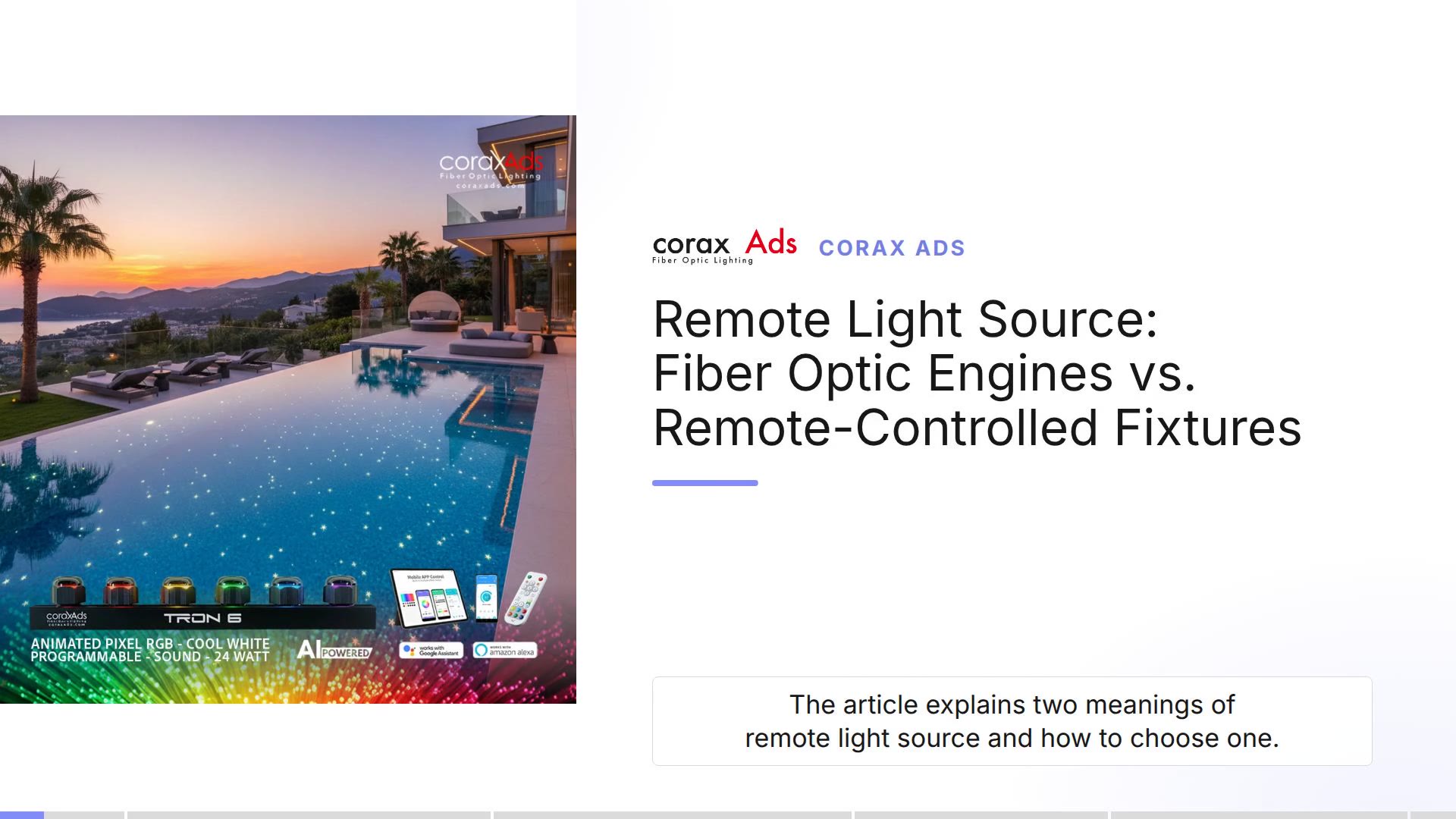
The article explains two meanings of remote light source and how to choose one.
Remote light source names a hidden illuminator that pipes light into a room. It also names a fixture controlled by a handset, an application, or a voice command. The physical distance and the control distance run in different directions.
An illuminator holds the lamp, color mechanics, and ports for the fiber bundle. Only light crosses into the room, so heat and ultraviolet stay outside. Service work happens at the housing instead of above a pool or glass floor.
You can add a smart bulb, a plug-in remote outlet, or an inline receiver. Fiber from a nearby engine or a plug-in pendant can light a ceiling without new wiring.
Check port count and leave one or two ports free for later changes. Longer runs need thicker strands to hold brightness across a large room. Confirm the remote type and whether spare handsets exist.
Details are in the article.
Table of Contents
- What does remote light source mean in practice?
- How a remote-source light engine moves light without a live fixture
- Can you add a remote to an existing light?
- How to get a ceiling light without wiring
- Which remote-controlled light fits each room
- What to check before you buy a remote light source
- Where these installations usually go wrong
- Frequently Asked Questions
What does remote light source mean in practice?
Remote light source names two different products: a remote-source system that pipes light from a hidden illuminator, and a fixture that answers to a handset, app, or voice command.
Search results mix them freely. One page sells under-cabinet pucks with a handset; the next sells laboratory illuminators and architectural light pipes. The word remote does the same job in both cases — it puts distance between you and the hardware — but the distance runs in different directions.
On the fiber side, the distance is physical. An LED or metal-halide engine sits in a closet, above a drop ceiling, or in a service corridor, and glass or acrylic strands carry the glow to a ceiling, a floor inlay, or a pool wall. Nothing at eye level carries current.
On the control side, the distance is only about reach. You keep the wiring and add a radio handset, a plug-in receiver, or a smart bulb. The fixture is unchanged; the switch simply moves into your hand.
How a remote-source light engine moves light without a live fixture
An illuminator holds the lamp, the color and twinkle mechanics, and the ports that grip the fiber bundle, so the only thing crossing into the room is light.
Open the housing and you find the lamp, a fan, a power supply, and a color wheel on a small motor. The front plate carries the ports, and each port clamps a single strand or a whole bundle.
A lens at the far end spreads, focuses, or softens the dot. Turning the wheel changes hue; a second motor adds twinkle. All of that happens at the box, out of sight.
The arrangement solves several problems at once. Heat stays in the housing. Ultraviolet stays with it. Service work happens at eye level instead of on a scaffold above a pool or a glass floor.
Light pipes and mirrored projectors use the same idea for commercial rooms, pushing daylight or lamp light down a tube to a diffuser so fewer fittings hang in the space. Facility teams like them because lamp changes drop to one accessible point.
Can you add a remote to an existing light?
You can add remote control to almost any fixture with a smart bulb, a plug-in remote outlet, or an inline RF receiver wired behind the switch.
The simplest route is the bulb. A screw-in smart lamp drops into the socket you already own and answers to a phone, a hub, or a voice assistant. No tools, no breaker, no landlord conversation.
When the switch box has no neutral, an inline receiver or a plug-in remote outlet sidesteps the problem. The receiver hides in the canopy or at the plug, and the wall switch stays as a manual override.
Radio remotes pass through drywall and cabinet doors. Infrared remotes need a clear line of sight to the receiver, so a deep upper cabinet can block them and leave you waving at nothing.
Dimming is the usual failure point. A lamp and a receiver rated for different dimming methods will buzz or flicker, so check both before you install anything.
How to get a ceiling light without wiring
Either bring light up from a remote engine through fiber or plug a fixture into a remote outlet, and the ceiling gets lit without a new circuit above your head.
Fiber gives the cleanest result. The engine sits on a closet shelf or above a drop ceiling, one bundle runs up the wall, and the ceiling holds only small lenses. No junction box, no electrician at height.
That matters in bathrooms and showers, where nobody wants a live fitting over the tub. It matters in older homes too, where fishing a new circuit means opening plaster and patching it afterward.
Renters have a faster option. Hang a plug-in pendant, loop the cord along the ceiling, and put it on a remote outlet. The room gets overhead light and the security deposit survives.
Star ceilings lean on fiber because they need many points, and one engine can feed the whole field. If you would rather not match parts yourself, ready-made fiber optic sets arrive with the engine, strands, and fittings already paired.
An animated fiber optic star ceiling motor handles drifting and shooting-star patterns, so the mood is set from the handset instead of at the ceiling.
Which remote-controlled light fits each room
Match the control type to the room: radio handsets for wet zones, app scenes for living spaces, and fiber engines wherever no current should reach the fitting.
Under-cabinet work in a kitchen wants warm white pucks and a handset that lives within reach. Motion sensing helps when your hands are full of flour.
Wet zones are a different job. Fiber optic pool lighting keeps the current in a dry niche, so the water's edge holds lenses and nothing else.
Boats and cars run on a 12 V supply, so fiber optic lighting for cars and boats is built around that voltage rather than a wall socket.
Hotels and restaurants usually want scenes: low and warm for dinner, brighter for the cleaning crew. Programmable engines and DMX give the front desk a single button for each.
In a home theater, deep dimming matters more than color. Pick an engine that reaches a true low level without stepping, then set the remote to hold that level.
What to check before you buy a remote light source
Port count, strand diameter against run length, and the remote's radio-or-infrared design decide whether a system works in your room.
Port count sets how many points you can run. Leave one or two free for a change of plan, because adding a second engine later costs more than buying a larger one now.
Longer runs lose less light when you step up to 3.0 mm fiber optic cables, which bend less tightly but hold their brightness across a big room.
Ask whether the remote is radio or infrared, whether the receiver matches the dimming you want, and whether spare handsets exist. A lost remote should not mean a new system.
For effect engines, check what the motor actually does — static, twinkle, drift, or meteor. An RGBW twinkle meteor light source adds movement to a plain star field without a second cable run.
CoraxAds cuts and assembles bundles at the Çankaya, Ankara workshop, so a room with odd ceiling heights still gets a matched set instead of shelf lengths and adapters.
Where these installations usually go wrong
Most failures come from a receiver packed inside metal, fiber bent past its limit, or a bundle too long for the engine's output.
Metal blocks radio. Put the receiver in a steel junction box or behind a metal fascia and the handset has to be pressed against the wall to work.
Fiber has a bend radius. Kink a strand behind a trim and the dot dims or dies, and no setting on the remote brings it back. Leave slack on every run.
Overlong runs lose light. If the ceiling is far from the closet, plan a bigger engine or thicker strands before the drywall goes up, not after the paint dries.
Frequently Asked Questions
Is there a way to control lights remotely?
Yes. Pick the route that fits the wiring you already have: a smart bulb for a plain socket, a plug-in remote outlet when the switch box has no neutral, or an inline radio receiver tucked behind the existing switch plate.
Can you add a remote to a light?
Almost always. The exception is a fixture with a sealed, non-dimmable driver inside, where an external receiver can only switch it on and off rather than dim it.
How do I get a ceiling light without wiring?
Run fiber from an engine that sits on a nearby shelf, or hang a plug-in pendant and put it on a remote outlet. Both skip a new circuit at the ceiling.
What is the best remote-controlled light?
There is no single winner. For a wet zone, fiber fed from a dry engine wins; for a rental, a remote outlet plus a plug-in shade; for schedules and scenes, a smart bulb on a hub.
Does a fiber optic ceiling need power above the ceiling?
No. The engine takes the power where you can reach it, and only non-electrified strands cross the ceiling, which is why the approach suits showers, pools, and glass floors.