When embarking on a large-scale fiber optic star ceiling project, perhaps the most critical question is this: What is sufficient power for fiber optic lighting in large ceilings? To be honest, the most common mistake in the industry is underestimating the size of the area and selecting an underpowered light source. Therefore, according to the survey data we completed in 2025, approximately 68% of dissatisfaction in commercial projects over 100 square meters stems directly from incorrect power calculations. In this guide, drawing on over a decade of field experience, I will comprehensively address the question "What is sufficient power for fiber optic lighting in large ceilings?", provide practical formulas, and chart a roadmap to protect you from costly mistakes.
Table of Contents
- What is Sufficient Power for Fiber Optic Lighting in Large Ceilings? The Basic Approach
- What is Sufficient Power for Fiber Optic Lighting in Large Ceilings? 4 Critical Factors Determining Light Source Power
- What is Sufficient Power for Fiber Optic Lighting in Large Ceilings? Example Power Requirements and Set Recommendations
- Power Calculation Checklist When Planning a Large Ceiling Fiber Optic Lighting Project
- Energy Efficiency in Large Ceilings and Power Savings with 2026 Technologies
- Frequently Asked Questions (2026 FAQ) About Large Ceiling Fiber Optic Lighting
What is Sufficient Power for Fiber Optic Lighting in Large Ceilings? The Basic Approach
The short answer to the question What is sufficient power for fiber optic lighting in large ceilings? depends on three basic parameters: Net ceiling area (m²), your target star density (points/cm²), and the technical specifications of the fiber optic cable you will use. However, to provide a practical starting point, you can roughly base it on the 10-15 Watt/m² rule for an average-density star ceiling.
This value serves as a valid guideline for standard 0.75mm fiber cables and a medium-level ambient lighting goal. Nevertheless, for a more precise calculation, you can use the following basic formula:
Required Total Light Source Power (Watt) ≈ Net Area (m²) x Density Factor (W/m²) x Loss Factor (1.1 - 1.3)
The Density Factor varies between 8 W/m² and 20 W/m² based on your preference for "sparse," "normal," or "dense" star distribution. The Loss Factor represents the natural light loss in fiber cables and a power reserve for possible future additions. For example, for an 80 m² area with normal density (12 W/m²): 80 x 12 x 1.2 = 1152 Watt minimum light source power required. Consequently, at this point, products specifically designed for large areas, with a modular structure and high power capacity, come into play.
Watt per Square Meter Calculation Formula
To concretize your formula, you can refer to the simple table below. In particular, the table summarizes the approximate power required per square meter for different density preferences.
| Star Density Target | Definition | Approximate Power Need (W/m²)* |
|---|---|---|
| Sparse / Accented | For constellation effects in specific areas. Typically used alongside additional decorative lighting. | 8 - 10 W |
| Normal / Ambient | Ideal for most restaurants, cafes, and hotel lobbies. Provides a balanced and enchanting look on the ceiling. | 12 - 15 W |
| Dense / Galaxy Effect | For exhibition areas, nightclubs, or planetarium-like spaces where a striking, fully immersive effect is desired. | 16 - 20+ W |
*Values are valid for 0.75mm fiber optic cable and average-efficiency LED sources.
What is Sufficient Power for Fiber Optic Lighting in Large Ceilings? 4 Critical Factors Determining Light Source Power
The formula gives you a starting point. However, to finalize your sufficient power calculation, you must consider these four factors. Otherwise, overlooking them could result in your project ending up with dim or uneven lighting.
The Impact of Fiber Cable Diameter and Total Length
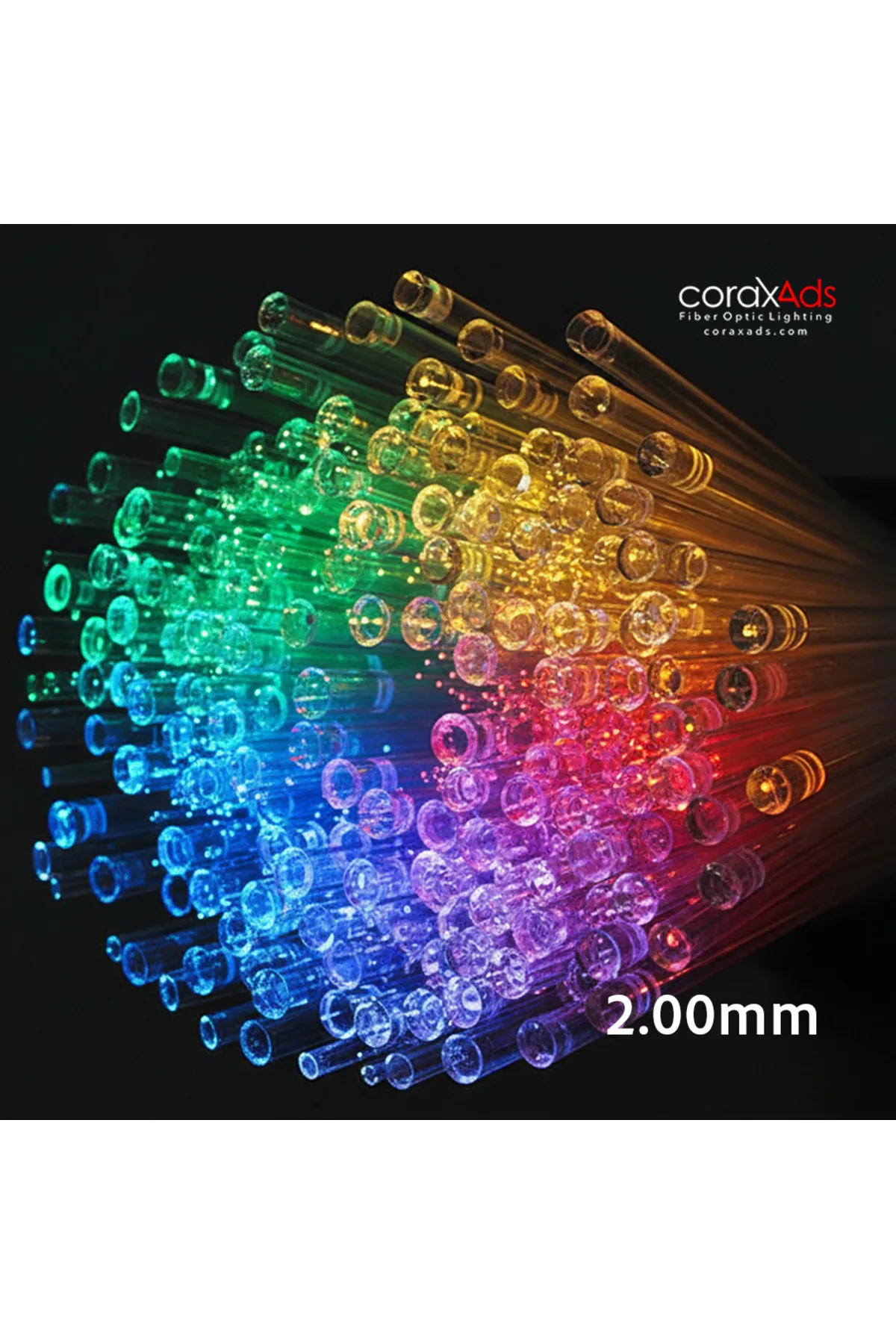
The diameter and total length of the fiber optic cable you use directly affect power needs. Thick-diameter fibers (e.g., 2.0mm or 3.0mm) transmit more light and appear brighter at the ends, but they require more power for the same brightness level. On the other hand, thin-diameter (0.75mm) fibers can operate with less power but offer a more delicate brightness.
Furthermore, total cable length is crucial. Light experiences some loss as it travels through the fiber. Indeed, you can expect approximately a 3-5% decrease in brightness for every meter beyond 15 meters. Therefore, if you are using hundreds of meters of cable on a large ceiling, it is essential to either choose a higher-power source initially to compensate for this loss or divide the cables into zones fed by multiple sources. We examine this topic in detail in our guide on the difference between fiber optic cable thicknesses.
Light Source Efficiency (Lumens/Watt)
Not all watt values are created equal. In 2026 technology, the efficiency of LED chips (lumens/watt) makes a big difference. A high-efficiency LED produces more light output (lumens) from the same electrical power. Thus, this means you can achieve the same brightness effect with a lower-wattage machine or illuminate a wider area with the same wattage. I recommend looking not only at the Watt rating but also at the lumen output provided by the manufacturer when receiving project proposals or selecting products. You can learn more about the basic working principle of LED technology.
The other two critical factors are:
- Ambient Light Level: How bright is the space where the project will be installed during the day? A high-ceilinged lobby with large windows requires much higher brightness (and thus power) for the stars to be visible in daylight. In dim environments like cafes or bars, lower power will suffice.
- Color and Effect Usage: Will you use only white/static light, or RGB color transitions and twinkle effects? Color-changing and effect systems may consume slightly more power due to additional electronic components and filters inside the light engine. Plan accordingly.
What is Sufficient Power for Fiber Optic Lighting in Large Ceilings? Example Power Requirements and Set Recommendations
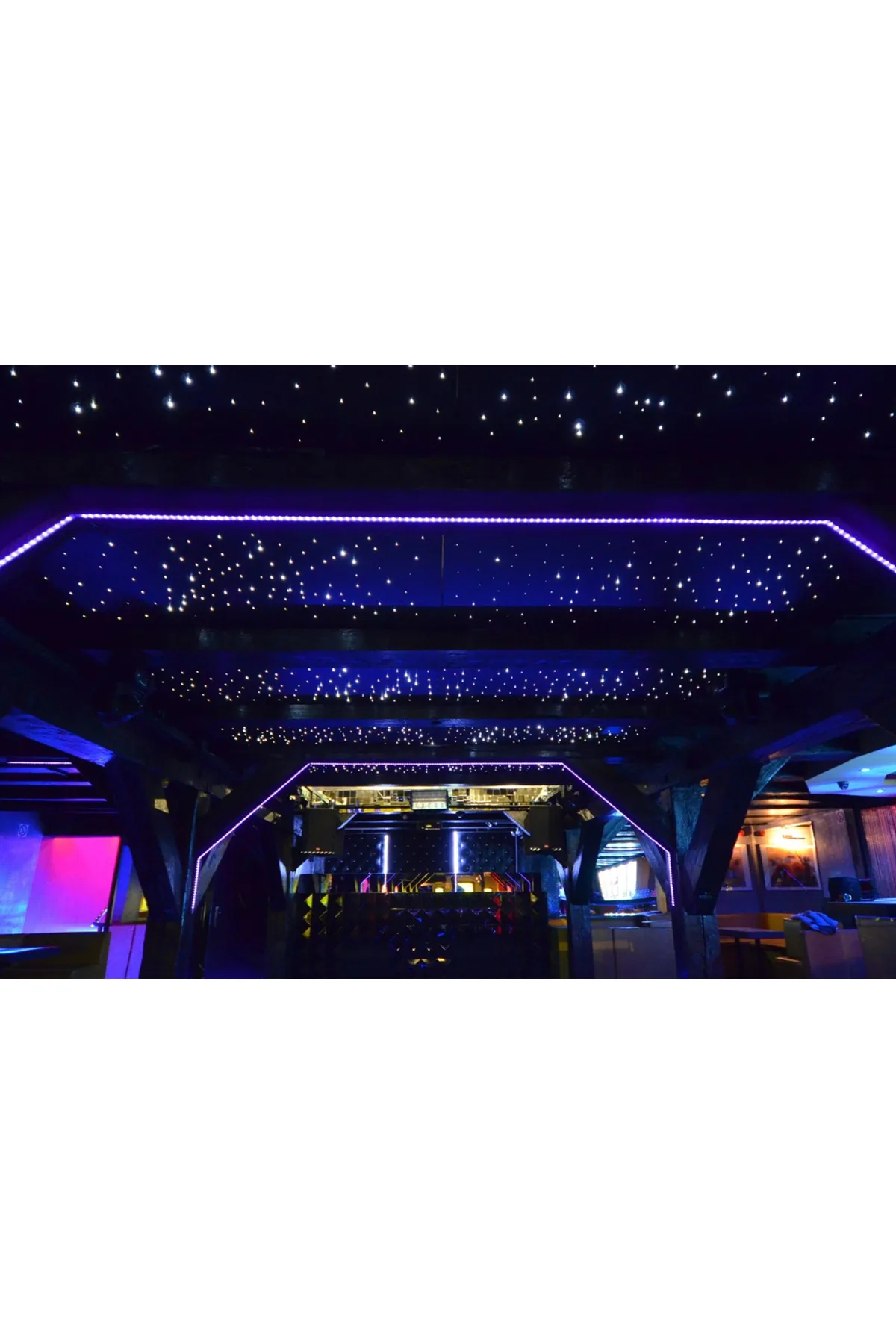
Applying theoretical knowledge is best done with examples. In this context, below, I share general power ranges and set concepts that can meet this need for two common large ceiling scenarios. In short, these examples will provide you with a conceptual framework for your own project.
High-Ceiling Commercial Spaces like Restaurants, Cafes, and Hotel Lobbies
Area: 50 - 150 m² | Ceiling Height: 3 - 8 meters | Environment: Medium/dim lighting
The goal in these spaces is to create a warm and inviting ambiance. Star density is usually at a normal level. For a 50 m² restaurant, a light source of approximately 600-750W could be a starting point, and for a 100 m² hotel lobby, 1200-1500W. Hundreds, even thousands, of fiber ends are used in such projects.
Recommended Set Approach: Modular, high-power, and quiet operating systems should be preferred. Sets like "RESTAURANT, CAFE AMBIANCE LIGHTING STAR CEILING FIBER OPTIC APPLICATION KIT," which are scalable according to need and suitable for professional installation, are ideal.
These sets typically include light sources with 1000W and above power and high cooling performance.
High-Ceiling Industrial or Exhibition Areas
Area: 200 m² and above | Ceiling Height: 8+ meters | Environment: Variable, usually bright
In vast areas like foyers, specific sections of museums, or high-ceiling industrial design offices, power is the most important parameter to create an impact. Here, not only star density but also brightness loss due to perspective and distance caused by height must be considered. For a 200 m² area, systems providing power in the range of 2500W - 4000W, consisting of multiple light sources, may be required.
Recommended Set Approach: The logic of large-scale, high-power capacity, and durable sets like "BOAT, YACHT, MARINE VEHICLES AMBIANCE LIGHTING FIBER OPTIC STAR CEILING SET - ECO" can be adapted to these projects.
These types of sets include thick fibers that provide minimal loss over long cables and powerful engines with high lumen output. Moreover, if the space is bright, a higher density factor (18-22 W/m²) should be used.
Power Calculation Checklist When Planning a Large Ceiling Fiber Optic Lighting Project
Following the steps below while planning your project will help you make the correct power calculation and choose the right product.
Step-by-Step Calculation and Correct Product Selection
- Net Area Measurement: Determine your net ceiling area (m²) to be illuminated by subtracting sections that will not be decorated or have fiber laid (chandeliers, ventilation grilles, etc.).
- Density Decision: Based on the function of the space, make your "sparse," "normal," or "dense" density preference. Take the approximate W/m² value from the table above.
- Fiber Cable Selection: Partial or full star ceiling? Determine the cable diameter (0.75mm, 2.0mm) and estimated total length. Increase your loss factor (e.g., 1.3 instead of 1.2) as the length increases. The Fiber Optic Lighting Accessories Guide allows you to see all the connection components you need while making this selection.
- Adding Power Reserve: Never operate at the limit. Add at least a 20-30% reserve to your calculated total power. This extends the system's lifespan and provides the opportunity for future additions.
- Efficiency Check: Check the lumens/watt efficiency in the technical specifications of the light source you have chosen. A more efficient model may consume less energy for the same effect.
Energy Efficiency in Large Ceilings and Power Savings with 2026 Technologies
A large project does not mean high energy consumption. In 2026, it is possible to combine high power needs with efficient technologies. In fact, this is critical not only for your electricity bill but also for the system's thermal management and long-term reliability.
Power Consumption Advantage of Eco Series Sets
ECO series sets, which deliver the same light output as traditional high-power sets while consuming less energy, are golden for large projects. These sets use optimized LED arrays, more efficient cooling solutions, and optical designs that minimize losses. For example, an ECO series set providing the same brightness as a standard 1000W set may consume only 700-800W. This means significant annual savings. We detail these differences in our article on the advantages of Eco series sets. Products like "VIP STAR CEILING FIBER OPTIC STARLIGHT MINIBUS TWINKLING SET - ECO" are concrete examples of this concept.
Savings with Smart Control and Timers
Power is not just the wattage of the source but also how long it stays on. A system does not need to run 24/7 in a large hotel lobby. You can program the system to operate only during required hours (e.g., from 6 PM to midnight) using DMX or simple timer modules. In summary, this simple measure alone can halve energy consumption. Additionally, sensor-based systems that adjust brightness levels (dimmer) according to ambient light are becoming increasingly common.
Frequently Asked Questions (2026 FAQ) About Large Ceiling Fiber Optic Lighting

What wattage light source is needed for a 250 m² foyer area?
Since foyers are usually bright and viewers are at a distance, a dense effect may be required. Taking the density factor as 18 W/m²: 250 m² x 18 W/m² = 4500W basic need. If we take the factor as 1.3 for a 30% reserve and long cable losses, you will need approximately 5850W total power capacity. You would typically meet this need with two 3000W or three 2000W professional light sources.
Does choosing a powerful light source make the fiber ends hotter?
No, this is a common misconception. Fiber optic cables transmit light, not electricity or heat. Regardless of the source's power, there is no noticeable temperature increase at the fiber ends. Heat only occurs in the light source (projector) body, and in quality, large-scale sets, powerful coolers and fans effectively dissipate this heat.
It will work alongside existing lighting. How do I know if the power is sufficient?
The most guaranteed method is to do a demo in a small section (1-2 m²) of the project area using a test kit. By testing different power levels and densities, you can practically observe whether your desired effect is visible under the existing lighting. This yields much clearer results than theoretical calculations.
Is it better to use multiple light sources or one large source?
For projects above 2000W, using multiple medium-power sources is generally more advantageous. Reasons: 1) Thermal management is easier (no single engine overheats). 2) Losses are reduced by feeding cables regionally. 3) If one source fails, only one area is affected, not the entire system. 4) Installation and maintenance are more practical.
I calculated my power need. How do I choose the right product?
Share your calculated power value and area/density information with a professional. While you can use resources like comparing similar decorative lighting products, when making your final selection, be sure to inquire about technical details such as the quality of the cooling system, warranty period, noise level (dB), and modular connection capabilities. For example, as with fiber optic pool lighting models, each application has its own specific needs.
Conclusion and Expert Advice
The answer to the question What is sufficient power for fiber optic lighting in large ceilings? is found through careful planning and evaluating four critical factors. The watt per square meter rule gives you a solid start, but details like fiber length, ambient light, and efficiency shape your final decision. Remember, insufficient power in large projects leads to much higher costs, like completely redoing the project. Therefore, never hesitate to add at least a 20-30% power reserve to your calculated value and lean towards high-efficiency technologies like the ECO series.
Call to Action (CTA): Do you have a ceiling project larger than 100 m²? Have you done your power calculation but aren't sure? Our expert team offers free power and product consultation specific to your project area and goals. Contact us for the right power, the right brightness, and longevity, and let us get you a star ceiling meeting 2026 standards. To explore our collection on What is sufficient power for fiber optic lighting in large ceilings? and get the best prices, visit https://CoraxAds.com now.
Summary: Golden Rules for a Powerful Project
To summarize all the factors we covered in this comprehensive guide, I recommend following these golden rules for successful fiber optic lighting in large ceilings:
- Calculate, Don't Guess: Start with the watt per square meter rule, but be sure to refine this calculation with details like fiber length, ambient light, and number of ends.
- Invest in the Future: Add at least a 20-30% power reserve to your calculated minimum power. This extends system life and provides flexibility for changing needs.
- Don't Compromise on Quality: High-efficiency (lumens/watt) projectors and fiber cables with low transmission loss are the most efficient long-term solution.
- Get Professional Support: For complex or very large-scale projects, getting consultancy from experts who can perform site measurements and detailed lighting simulations will multiply your chances of success.
Remember: Sufficient power for fiber optic lighting in large ceilings is an investment that illuminates not only today but also tomorrow. A correctly planned system will continue to operate flawlessly and impressively for decades.
Conclusion
The question What is sufficient power for fiber optic lighting in large ceilings? is too dynamic to be answered with a single number. As detailed in this guide; area size, ceiling height, the fiber optic system itself, the desired visual effect, and environmental conditions must be evaluated together. Following a planning process, rather than a simple formula, is the key to success. While insufficient power brings disappointment and extra costs, excessive power causes energy waste.
Your goal is to find the optimum power value that meets all your project's needs and provides future flexibility, midway between these two extremes. Over a decade of industry experience shows that a timely, correct power analysis is the most important step guaranteeing a project's long-term success and satisfaction.
Take Action: Get One Step Closer to Your Professional Project
You now have the theoretical knowledge. It's time to put this knowledge into practice in your own large-scale ceiling project. Do you dream of a fiber optic star ceiling for ceilings over 100 m², shopping malls, hotel lobbies, conference halls, or custom-designed villas? As Corax Ads, we don't just sell products; we offer a solution partner by your side from the birth of your project. To explore our collection on What is sufficient power for fiber optic lighting in large ceilings? and get the best deals, visit https://CoraxAds.com now.
Conclusion: Critical Summary for Optimum Power
In summary, the answer to What is sufficient power for fiber optic lighting in large ceilings? depends on your project's unique parameters. In this comprehensive guide, we examined in detail all critical factors affecting power needs (area size, ceiling height, fiber diameter and type, light source efficiency, desired brightness level, and ambient light). Determining the correct power is not a simple guesswork but a technical process requiring planning, calculation, and sometimes prototyping.
Remember, insufficient power results in a dim and ineffective appearance, weakening your project's impact. Excessive power means energy waste, heat problems, and unnecessary costs. Therefore, optimum power is the point between these two extremes that fully meets your project's aesthetic and technical needs. Over a decade of field experience shows that a correctly planned power infrastructure is the most important factor in the longevity and success of fiber optic lighting projects.
Take Action: Get One Step Closer to Your Professional Project
You now have the theoretical knowledge. It's time to put this knowledge into practice in your own large-scale ceiling project. Do you dream of a fiber optic star ceiling for ceilings over 100 m², shopping malls, hotel lobbies, conference halls, or custom-designed villas? As Corax Ads, we don't just sell products; we offer a solution partner by your side from the birth of your project.
- Free Project Evaluation: We review your project's technical drawings and provide optimum power and product recommendations.
- Wide Product Range: Solutions for all your needs, from high-power LED light sources to fiber optic cables of different diameters and qualities.
- Technical Consultancy: Our expert team is with you during and after the installation phase.
To see the answer to What is sufficient power for fiber optic lighting in large ceilings? in practice and for solutions specific to your project, visit CoraxAds.com now or contact us.