
Fibre optic lighting for saunas and steam rooms is a system where a projector stays outside the hot, wet space and pushes light along thin strands to small lenses set into ceilings, benches or walls. Nothing electrical enters the cabin. That single fact is why the approach suits rooms that reach high temperatures and near-constant humidity, where ordinary fittings fail early.

- Because the projector sits outside the cabin, a fibre optic sauna has no electrical component inside the hot room.
- In hot and wet installations, connectors, ferrules and seals fail before the fibre itself does.
- Every fibre entry into a steam room is a penetration in the vapour barrier and needs a sealed lens housing or gland.
Video summary of this article
Watch this video on its own page
Video transcript
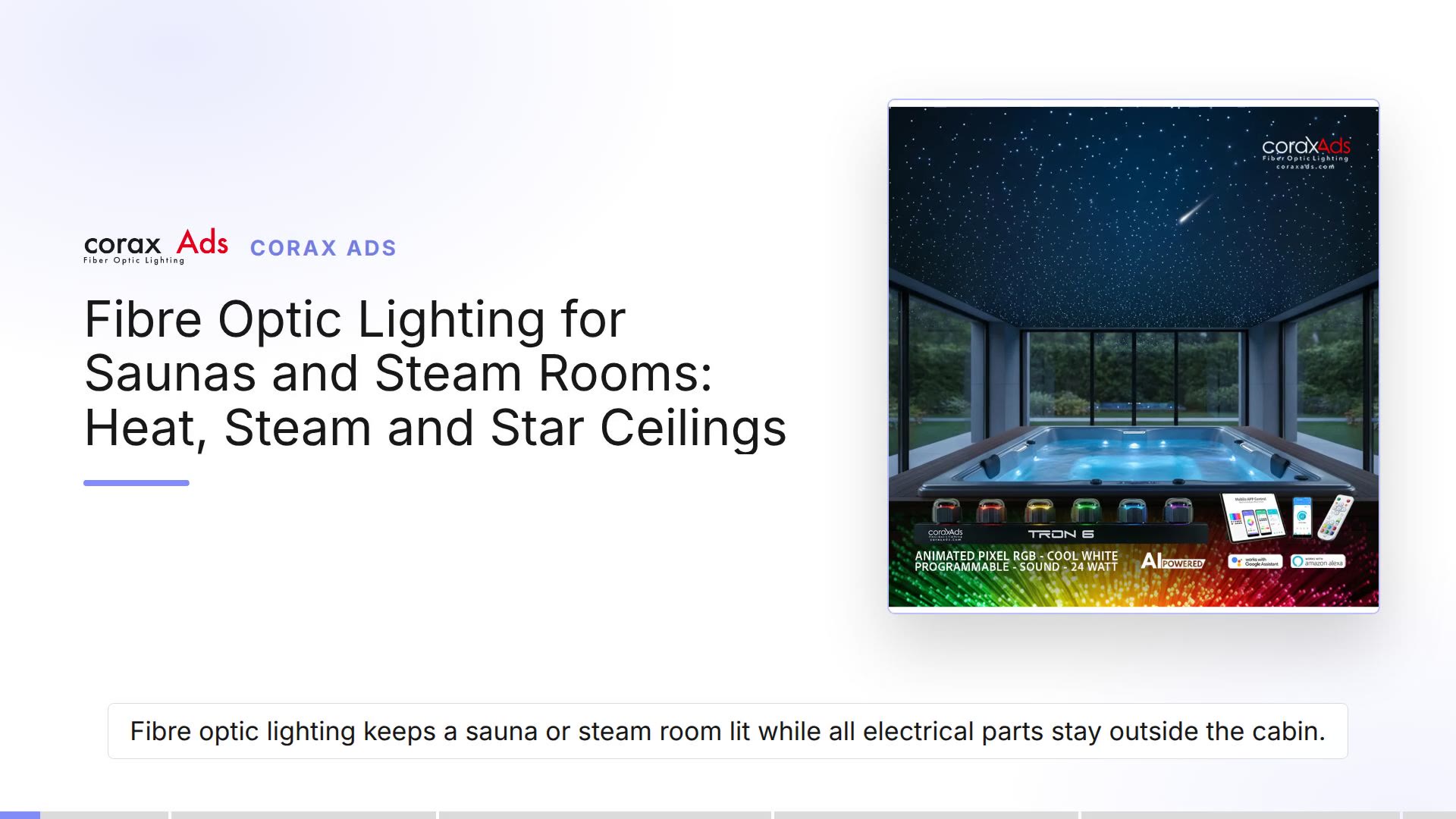
Fibre optic lighting keeps a sauna or steam room lit while all electrical parts stay outside the cabin.
A projector sits outside the cabin and sends light along thin strands to small lenses. Nothing electrical enters the hot room, so heat and steam never touch a live lamp.
In hot or wet rooms, connectors, ferrules and seals often fail before the fibre itself does. Saunas are hotter and drier, while steam rooms need every fibre entry sealed against water. Metal ferrules and heat resistant sleeving help both cases.
Thicker fibre carries more light for long runs and bright feature points. Thinner fibre gives finer, more numerous points in tight layouts. Plan gentle curves, because a tight kink steals light permanently.
Draw the ceiling in plan and mark the benches first. Pick a focal point above the upper bench and let density fall away from it. Fibre needs a void behind the panel and steam rooms need lens housings on the drawing.
The full details are in the article.
Table of Contents
- Why fibre optic lighting suits hot, wet rooms
- Heat, humidity and the connectors that hold up
- Picking the right fibre diameter
- Planning a star ceiling above the bench
- Sealing the cabin: vapour, water and steam
- Choosing light sources and effects
- Maintenance that actually matters
- What we need from you to specify a layout
- Frequently Asked Questions
Everything we stock for hot, wet interiors sits together under fibre optic lighting for steam rooms, which makes comparing housings and seals far quicker.
Why fibre optic lighting suits hot, wet rooms
A fibre optic system keeps all electricity outside the cabin, so heat, steam and condensation never touch a live lamp or driver.
In a conventional sauna or steam room, every light fitting is a compromise. Heat cooks the driver, steam finds the gasket, and the lamp that looked fine on the drawing ends up with condensation behind the lens. Fibre optics remove the argument entirely. The projector sits in a plant space or service corridor, and only non-conductive strands cross into the cabin.
What lands in the ceiling is little more than a polished lens and the end of a strand. There is no heat output above the bench, no warm spot on the timber, and nothing to switch off at the door. In a steam room that also means no metal housing quietly corroding in saturated air.
There is a maintenance argument too. Once the harness is in, the service point is the projector in the corridor, not the cabin. Nobody has to climb into a hot room with a ladder and a screwdriver to change a lamp.
Heat, humidity and the connectors that hold up
Connectors, ferrules and seals fail before the fibre does in hot or wet installations, so we specify heat-tolerant types and keep them reachable.
One question comes back from clients building saunas, steam rooms and heat-test chambers: fibre optic connectors for extreme temperatures. The honest answer is that connectors, not the fibre, are usually the first thing to soften, cloud or crack.
PMMA fibre has a working ceiling well below the surface temperature of a sauna bench, so a strand end needs a lens or ferrule that shields it. Glass fibre takes more heat but demands careful termination. Either way, the body, the ferrule and the fixing carry the risk, so we specify metal where plastic would creep.
Where the design allows, we keep connectors away from the hottest zone and use heat-resistant sleeving on the run up the wall. In steam rooms the second enemy is water tracking along a strand, so every entry gets sealed and the projector stays in dry air.
Picking the right fibre diameter
Thicker fibre carries more light for long runs and bright feature points, while thinner fibre gives finer, more numerous points in tight layouts.
Diameter affects brightness, bend radius and how many strands fit through one drilled hole. The three sizes we supply most are 0.75 mm, 1.5 mm and 3.0 mm. The choice is usually driven by the effect you want rather than by the size of the room.
A dense, subtle field of tiny points is the thinnest fibre's job. Where you want a brighter star, or a run of several metres from a projector in the next room, step up a size. The heaviest fibre is for feature points you want people to notice from across the room.
Bend radius matters more than most people expect. A tight kink will steal light permanently, and it will do it behind a sealed ceiling where you cannot reach it. Plan the harness route with gentle curves before anything is drilled.
Planning a star ceiling above the bench
A good sauna star ceiling is drawn around the seating, not the joists, so the points sit where a bather actually looks.
Draw the ceiling in plan and mark the benches first. Star points that look random on paper often read as rows once the room is warm and the ceiling is the only thing in view. Pick a focal point, usually the corner above the upper bench, and let the density fall away from it.
Structure comes next. Fibre needs a void behind the panel for the harness, and the projector needs a serviceable spot with enough distance for the strands to reach without tight bends. If the ceiling is insulated, settle the route before the foil goes up.
For steam rooms, add the lens housings to the panel drawing. Each one is a penetration, and the panel supplier needs to know where they fall so the vapour barrier can be detailed around them.
Sealing the cabin: vapour, water and steam
Every fibre entry into a steam room needs a sealed lens housing or gland, because steam will find an unsealed hole and travel along the strand.
Steam punishes small mistakes. A hole drilled for a star point is a hole in the vapour barrier, and warm moisture will use it. We specify lens housings that seal to the panel face, and we keep the projector in a ventilated space outside the cabin.
Saunas are drier but hotter, so the worry shifts to timber movement and to anything plastic softening near the ceiling. Silicone seals, metal ferrules and heat-resistant sleeving cover both cases. On a sloping ceiling, drill perpendicular to the panel rather than vertically.
If the room is being refurbished, test the enclosure before the fibre goes in. Finding a leak after the harness is dressed and the lenses are sealed is an expensive way to learn.
Choosing light sources and effects
The projector decides the colour, movement and brightness of every point, so it is worth choosing before the ceiling is drilled.
The projector sets the colour, movement and brightness of every point in the room, so it deserves more thought than the ceiling pattern. A single-colour white unit gives a calm, spa-like feel. RGBW adds scene changes for a home wellness suite.
Twinkle and shooting-star effects need a driver that can address points individually, and that usually means a slightly larger housing. In a domestic sauna the housing lives in the corridor or plant room, so size is rarely the constraint.
Animation is the other option for commercial work. A slow drift across the ceiling reads as heat shimmer in a steam room and gives bathers something to watch when the room is quiet.
Maintenance that actually matters
Servicing a fibre optic sauna means checking the projector and the fibre ends, not climbing into the cabin to change lamps.
Servicing is straightforward once you know where to look. The lens faces in the cabin collect a film of oils and minerals, so wipe them with a soft cloth as part of the normal cleaning round. Never use an abrasive on a plastic lens.
At the projector, check the fan and filter. A blocked filter on a warm plant room shelf will shorten the life of the LED module, and that is the part most likely to need replacing. Keep a spare module for commercial rooms.
If a single point goes dark, it is usually a strand that has been pulled or a connector that has shifted, not the fibre failing along its length. Both are fixable from the projector end in most layouts.
What we need from you to specify a layout
A ceiling plan, the room type and the effect you want are usually enough for us to specify a sauna or steam room layout without a site visit.
We are CoraxAds Fiber Optic, working out of Çankaya in Ankara with sauna builders, spa contractors and fit-out firms. A ceiling plan, the room type and the effect you have in mind are usually enough for us to specify a layout.
Ring us and we can talk through connector choice, fibre diameter and where the projector should sit. We answer calls Monday to Friday between 09:00 and 18:00, and on Saturday until 15:00.
For a steam room, tell us how the vapour barrier is built. That single detail decides which lens housings we recommend and whether the entries need extra sealing detail on the drawing.
For a sauna where you want movement as well as colour, the RGBW twinkle meteor light source can drive several points from one projector outside the cabin.
Frequently Asked Questions
Are fibre optic connectors available for extreme temperatures?
Yes, but you have to choose them deliberately. Metal ferrules, heat-resistant sleeving and short runs near the hot zone do most of the work, and the projector should always sit outside the cabin.
Can fibre optics be used in a steam room?
They can, provided every entry point is sealed. The fibre itself copes fine with moisture; the risk sits at the lens housing, the drilled hole and the vapour barrier around it.
Will the fibre get hot in a sauna?
No. It carries light rather than heat, and the only heat at the ceiling is the room's own. That is why it stays cooler than a recessed fitting with a driver behind it.
What happens if one star point stops working?
Usually a pulled strand or a connector that has shifted at the projector end. It can normally be re-seated from outside the cabin, without opening the ceiling.
Can I add fibre optics to an existing sauna?
Only if you can get behind the ceiling panel. Retrofit means lifting panels for the harness, so it is far easier to plan the fibre at the build stage.