
A starlight headliner for a boat cabin is a fiber optic ceiling: a bundle of thin strands lit by one small light source and set into the cabin liner so the surface reads as open sky. What it costs depends far less on the lights than on the ceiling they go into — how dense the star field is, how much wiring hides behind it, and how many hours someone spends drilling, gluing and trimming from below.

- On a boat, installation labor typically matches or exceeds the cost of the fiber optic hardware itself.
- Strand density and the light engine are the two variables that shift a starlight headliner quote the most.
- Rolls-Royce popularized the starlight headliner as a factory option; in boats and in Teslas it is always an aftermarket addition.
Video summary of this article
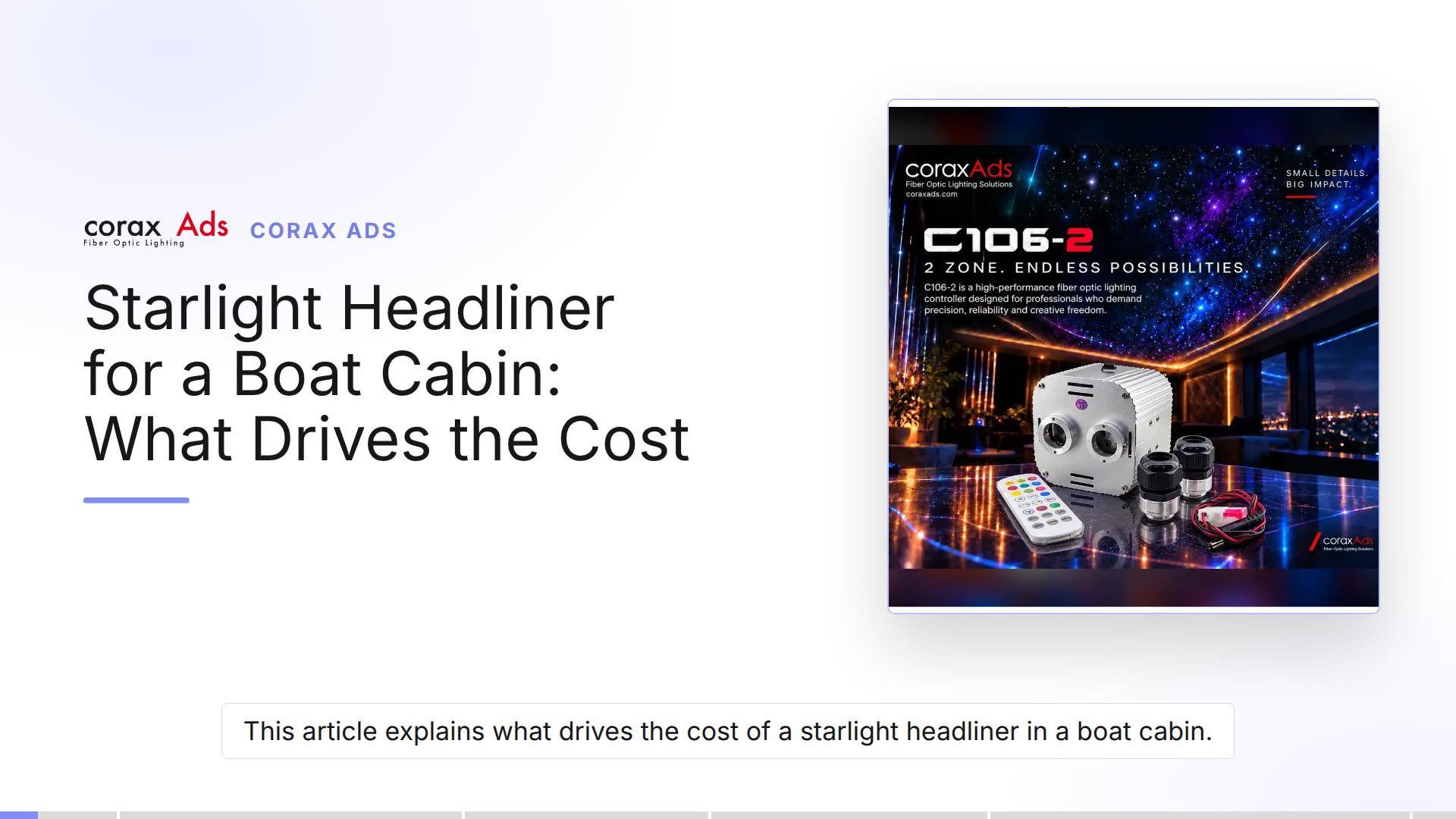
Watch this video on its own page
Video transcript
This article explains what drives the cost of a starlight headliner in a boat cabin.
Four things set the price: strand count, light source, marine sealing, and routing hours. Boat cabins are often smaller than car roofs, which can help the budget. Access still matters, because a removable panel is easier than a packed, bonded ceiling.
A ready kit keeps the total low and predictable. A custom build trades money for control over layout, density, and light behavior. Most boat cabins do not need a custom build.
Strand count sets the density of the sky and the hours of drilling. The light source sets whether the ceiling twinkles, shifts color, or stays still. Twinkle and shooting star effects come from the module, not the fiber.
Salt air, condensation, vibration, and heat push a boat install toward sealed connectors and protected runs. The fiber handles marine conditions well, but the terminations are what fail. Labor usually matches or exceeds the hardware cost, because every strand is drilled, inserted, glued, and trimmed by hand.
The article has all the details.
Table of Contents
- What actually sets the price of a boat cabin starlight headliner
- Kit or custom build: two different budgets
- Strand count and the light engine are the two levers
- What marine conditions add to the job
- Labor is the line item owners underestimate
- How to scope the project before you ask for quotes
- Frequently Asked Questions
What actually sets the price of a boat cabin starlight headliner
Four things set the price: how many fiber optic strands go in, which light source drives them, how much marine-grade sealing the ceiling needs, and how many hours the routing and finishing take.
A starlight headliner is a fiber optic ceiling. Hundreds of thin strands run from one light engine and terminate in the cabin liner, so the surface reads as a night sky. Boat cabins are usually smaller than a car roof, and that helps your budget more than most owners expect.
Size is only half of it. Two cabins that look the same on paper can quote far apart, because access decides the job. A cuddy ceiling with a removable panel is a short day. A salon ceiling packed with wiring, ducting and a bonded liner is not.
So when you ask about cost, ask it as three questions instead: how big is the ceiling, what sits above it, and what effect do you want. Answers to those three move the number more than any brand of strand or any particular module.
Kit or custom build: two different budgets
A ready kit keeps the total low and predictable, while a custom build trades money for control over layout, density and light behavior.
Most boat cabins do not need a custom build. A kit bundles the light engine, the fiber bundle, the drill bit and the fittings in one box, and the ceiling gets covered with strands left over. Fewer decisions, fewer invoices, fewer things that arrive late.
A custom build makes sense when the ceiling is unusual — a curved hardtop, a berth with a recessed panel, an owner who wants a specific constellation in a specific spot. That control is real. So is the extra labor behind it, and so is the planning time before anything gets drilled.
If your cabin ceiling is small and flat, a VIP starlight fiber optic kit for vehicle ceilings is the shortest route to a finished sky. Vehicle kits migrate to boats well, because both ceilings are thin, curved and easy to drill from below.
Strand count and the light engine are the two levers
Strand count sets the density of the sky and the hours of drilling, while the light source sets whether it twinkles, shifts color or stays still.
A sparse ceiling of a few dozen points looks like scattered dust. A dense one looks like the Milky Way. Density is the easiest thing to change and the easiest thing to regret skimping on, since adding strands later means pulling the liner down a second time.
The light engine sits at the other end of the bundle. A single-color source is the cheapest way to get a star field, and it does the job. Swapping in an RGBW twinkle light source changes the whole mood of the ceiling without adding a single strand, which is usually the better trade for the money.
Twinkle and shooting-star effects come from the module, not from the fiber. If you want movement running across the ceiling, pay for the module first and add strands second. Boats ask one question cars never do: where the engine lives. Put it behind a service panel you can reach without tearing the ceiling apart, and future repairs stay cheap.
What marine conditions add to the job
Salt air, condensation, vibration and heat push a boat install toward sealed connectors, tinned cable and strain-relieved fiber runs, and every one of those adds time.
A car ceiling sees dry air and the occasional spilled coffee. A boat cabin sees humidity that never fully leaves, salt that finds every gap, and vibration from the engine and the hull. The fiber itself handles all of this well. The terminations are what fail.
That means heat-shrink on the bundle ends, a light engine mounted where it will not sit in a puddle of condensation, and fiber runs tied off so they cannot chafe against a frame. None of this is exotic hardware. All of it takes longer than the equivalent car job.
Our walkthrough of a starlight headliner kit for boats and yachts shows how the strands are bundled before they ever reach the ceiling. Getting that bundle right is what keeps a marine ceiling alive past the first season, and it is the part most DIY installs skip.
Labor is the line item owners underestimate
Labor usually matches or exceeds the hardware cost, because every strand is drilled, inserted, glued and trimmed by hand from below.
There is no machine that lays a star ceiling. Each point is a drilled hole, a strand pushed through, a dab of adhesive and a flush trim. On a dense ceiling that is a long, quiet, repetitive job, and it is where the hours quietly go.
The drilling and gluing sequence in our fiber optic star ceiling installation walkthrough is the same one we use on marine ceilings, only with more sealant and more care around wiring. Watch it before you decide whether to hire the work out or take it on yourself.
Doing it yourself is reasonable on a small, removable panel. On a finished salon ceiling the real risk is not the fiber — it is the liner you cannot replace once the holes are in it.
How to scope the project before you ask for quotes
Measure the ceiling, photograph what is behind it, decide the effect and pick the light source before you compare quotes, or you will be comparing different projects.
Start with a tape measure and a phone camera. Photograph the ceiling, then photograph the back of it through any access hatch. Note where wiring and ducting run. Anyone quoting without those photos is guessing, and you end up paying for the guess.
Next, describe the effect in plain words: still stars, twinkling stars, color-changing, shooting stars. Then match the module to it. Our fiber optic device selection guide is built around that order, because picking the light source last is exactly how budgets drift.
Decide early whether the starlight ceiling replaces your cabin lighting or complements it. A star field is ambience, not task light, so keep a separate circuit for reading and cooking. Then ask for the quote in two parts — materials and install hours. A lump sum hides whether you are paying for a denser sky or a harder ceiling, and those negotiate very differently.
Frequently Asked Questions
What does a starlight headliner for a boat cabin cost?
There is no single number, and anyone quoting one before seeing your ceiling is guessing. Density, access and the light engine do most of the work. A small removable panel with a basic single-color source sits at the low end; a dense, color-changing ceiling in a finished salon with limited access sits at the top.
What is a Tesla starlight headliner?
Tesla does not offer one from the factory. The ones you see in videos are aftermarket fiber optic installs — strands set into the headliner and driven by a small light engine. Same parts, same process we use on boat ceilings, just a different ceiling above your head.
Can I install one myself in a boat cabin?
Yes, on a small panel you can take down and work on at a bench. It stops being a good idea once the liner is bonded and you cannot undo a mistake. If you cannot replace the ceiling, hire the drilling out.
Will the fibers hold up to salt and moisture?
The fiber does fine. The ends and the connections are the weak point, so seal the bundle, keep the light engine out of standing condensation, and tie the runs so they cannot rub. Done that way, a marine install lasts.
How long does a boat cabin install take?
A removable panel with a modest star count is a weekend project. A dense ceiling in a finished cabin runs into several days of shop time, mostly drilling and trimming. The fiber work is not slow — the finishing is.